
History of Presidents Hill
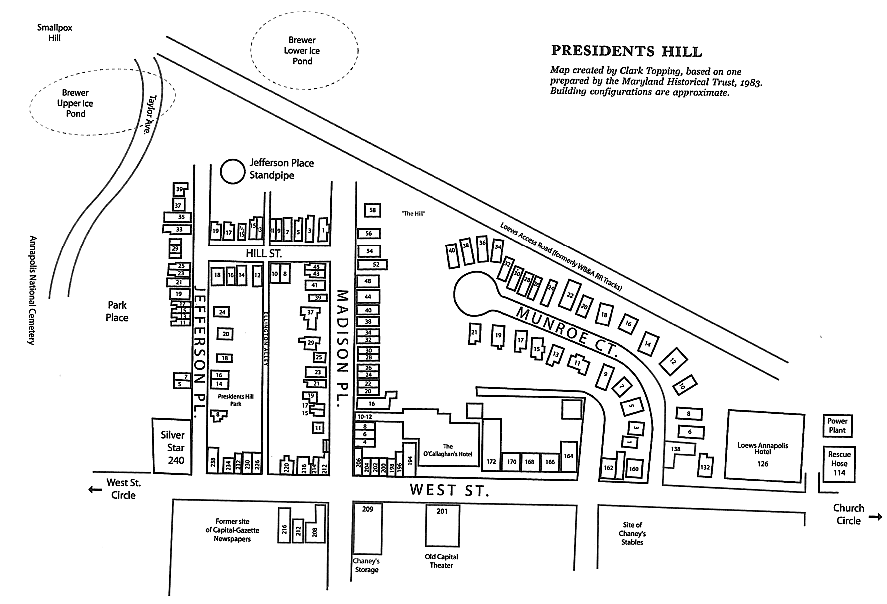
Presidents Hill is one of the most storied neighborhoods in Annapolis, Maryland. Its history stretches back over 350 years — from colonial-era land grants to the vibrant community it remains today. The land was originally part of Todd’s Range, a large colonial land grant patented in 1664 by Thomas Todd, Jr., one of the original settlers of the Annapolis peninsula. For nearly two centuries the area remained straggling farmland just outside the city gates, until three prominent families — the Brewers, the Tucks, and the Munroes — transformed it into a residential neighborhood in the late nineteenth century. What follows is a summary drawn from the definitive neighborhood history by Michael Parker and local journalism.
The Neighborhood Takes Shape
Presidents Hill is a small neighborhood of four streets — Munroe Court, Madison Place, Hill Street, and Jefferson Place — located immediately to the west of Annapolis’ Historic District, tucked behind the Arts District. It is bounded by the hotel access road to the north, the Loews Annapolis Hotel to the east, West Street to the south, and commercial lots to the west. The neighborhood encompasses approximately 115 homes.
Topographically, the neighborhood is bisected by a low ridge that crosses West Street just west of the entrance to Munroe Court. The soil is a rich, sandy loam that made the area highly productive farmland in the nineteenth century. The circle at the end of Munroe Court was originally an upland bog or vernal pond, and a clay pan still underlies this portion of the ridge.
In 1800, Presidents Hill was straggling farmland just outside the city gates. By the 1870s, it had been transformed into an elegant suburb of small estates. As the Brewer and Munroe families developed their properties, the neighborhood grew into a close-knit residential community where extended family networks were the sinews that held everything together.
The Street Names
Despite what the name “Presidents Hill” might suggest, not every street is named for a U.S. president. Hill Street is named after a commander-in-chief. Munroe Court takes its name from the Munroe family (and by association James Monroe, the fifth president). Madison Place honors President James Madison. Jefferson Place honors Thomas Jefferson. There were even plans in the late 19th century to name a street “Hamilton Street” after Alexander Hamilton, though it never took hold.
The presidential connections run deeper than just street signs — George Washington himself made over 20 trips to Annapolis, and as author Mike Parker noted, “every president that came to Annapolis would have come right past West Street.”
The neighborhood itself didn’t acquire the name “Presidents Hill” until around the 1960s, when residents banded together out of concern about the decline of nearby West Street. Artist Jeff Hartington later painted a mural on Madison Place in 2016 featuring former presidents James Madison, Theodore Roosevelt, and Abraham Lincoln — a tribute to the neighborhood’s presidential namesakes.
Daily Life in Early Presidents Hill
Life on Presidents Hill in the late 19th and early 20th centuries was shaped by the rhythms of a small city still modernizing. Before the city water system reached the neighborhood, residents on Madison and Jefferson depended on wells for their water supply. The Annapolis Water Company was chartered in the late 1860s, but comprehensive downtown water lines weren’t installed until 1894. Even after tap water arrived, it was far from pristine — the Evening Capital reported in May 1914 that a nurse drew “a glass of water from a spigot at the Emergency Hospital” and found “two tadpoles and a tiny worm, together with fungus” in it.
Hot water was a luxury for all but the wealthy. A bath required heating water bucket by bucket over a stove. Monday was wash day in most households, and the women of extended families would often gather at a single house to do laundry together — practical and social in equal measure. Elsie Clark remembered how in summer she and her neighbors would hang clothes to dry by moonlight.
A 1911 typhoid outbreak in the West End was traced to a well owned by Harry Elliott at the intersection of West and Spa Road, a reminder of the health hazards that came with the old infrastructure.
A Diverse and Close-Knit Community
Throughout the early twentieth century, Presidents Hill residents patronized the same businesses, congregated at the same clubs, and voted the same way. They practiced a surprising degree of endogamy — preferring to marry someone from the same street rather than someone from across the bridge. When daughters married, it was common for them to set up housekeeping close to their parents. As many Presidents Hill natives recalled of their youth: “Everyone was just like family.”
Beneath this apparent homogeneity lay a surprising amount of diversity. Presidents Hill encompassed a wide variety of religious belief — Protestant, Roman Catholic, Greek Orthodox, and Jewish — and religious intolerance seems to have been largely unknown. While the original residents were almost all of northwestern European descent, the neighborhood was quick to welcome Eastern and Southern European immigrants who settled Munroe Court in the 1920s, and later the African-Americans and Latinos who began to arrive in the 1970s.
Socioeconomically, Presidents Hill has never been just a working-class neighborhood or a middle-class one. From its founding, the community included lawyers, laborers, professors, plasterers, mayors, and mechanics. This diversity persists today and is perhaps the most distinctive characteristic of the neighborhood.
Presidents Hill Today
Today, Presidents Hill remains an affordable, eclectic neighborhood in the heart of Annapolis. It sits behind the Arts District and is home to local businesses along West Street. Residents continue to take pride in the community’s deep roots and strong identity. As one resident put it: “It’s a time to think about our founding fathers and reflect on their legacies — good and bad — and to think about why we don’t know the founding mothers.”
The Presidents Hill Community Association (PHCA) carries forward the tradition of neighbors looking out for one another — organizing events, maintaining the neighborhood park, and preserving the history that makes this corner of Annapolis so special.
Sources & Further Reading
- Parker, Michael P. Presidents Hill: Building an Annapolis Neighborhood, 1664–2005. The Annapolis Publishing Company, 2008. — The definitive history of the neighborhood, based on over a decade of research, nearly 100 interviews with residents, and over 300 photographs and historical records.
- Lumpkin, Lauren. “Presidents Hill residents reflect on history, future of their neighborhood.” Capital Gazette, February 18, 2019.